
In District 214, multilingualism is recognized as a strength that students bring into every classroom, as the schools, like the communities they serve, become increasingly global.
That was a key message from Veronica Gott, the District’s Director for the English Learner Program, as she recently updated the Board of Education on the District’s multilingual programming and ongoing work to support students academically, socially and emotionally.
Gott said multilingual programming is central to District 214 preparing students for a world where language, culture and connection matter. “It reflects the global nature of our population,” she said.
District 214 serves 2,422 English Learners representing 92 language groups. Spanish is the largest group, followed by Ukrainian, Russian, Polish and Arabic. Since 2020, the percentage of English Learners has grown from 9.5 percent to almost 22 percent. Multilingual learners are also learning across the entire school experience. In 2016, 28 percent of district courses included English Learners. Today, that number is nearly 70 percent.
Gott highlighted the growing scale of multilingual learning in District 214, students’ progress and next steps to ensure that multilingual learners have access to rigorous instruction and a sense of belonging.
Language development is no longer limited to one program or one classroom. When students who have exited English Learner services are included, about 45 percent of District 214 students benefit from continued language development support.
“We are making language accessible without lowering expectations,” Gott said. “We are building EL-responsive classrooms and conducting ongoing professional learning to ensure every teacher is equipped to serve multilingual learners.”
Toward that end, the District provides an EL endorsement incentive, which provides 100-percent reimbursement. Since 2024, 58 educators have completed the endorsement. The District is also designing curriculum, units and lessons with embedded language supports so students can engage with grade-level content while continuing to develop academic language.
District 214’s multilingual programming has expanded to include newcomer supports across all six comprehensive high schools, aligned ESL coursework, mentorship, after-school programs, field trips and college visits. Gott said that District 214 educators have also developed social-emotional learning supports that help students build confidence, connection and belonging as they adjust to a new school system, a new language and, in many cases, a new country.
District 214 has developed a Newcomer Family Toolkit, including student-created videos, and strengthened interpretation and translation systems so families can better access information and participate in decisions. These supports include phone, in-person and video interpretation.
Board members praised the depth of the work. Board member Frank Fiarito reflected on a recent family event that drew a packed audience despite poor weather and an uncertain environment. He described as “profound” Gott’s encouragement of families to continue speaking their native language at home while District 214 helps students grow in English.
“Ultimately we want our students to be bilingual and proud, never feeling like they have to leave part of their heritage behind,” Gott said.
Maintaining and developing a home language, she said, does not compete with English language development. “We consistently maintain that maintaining home language is not a barrier but a strength.”
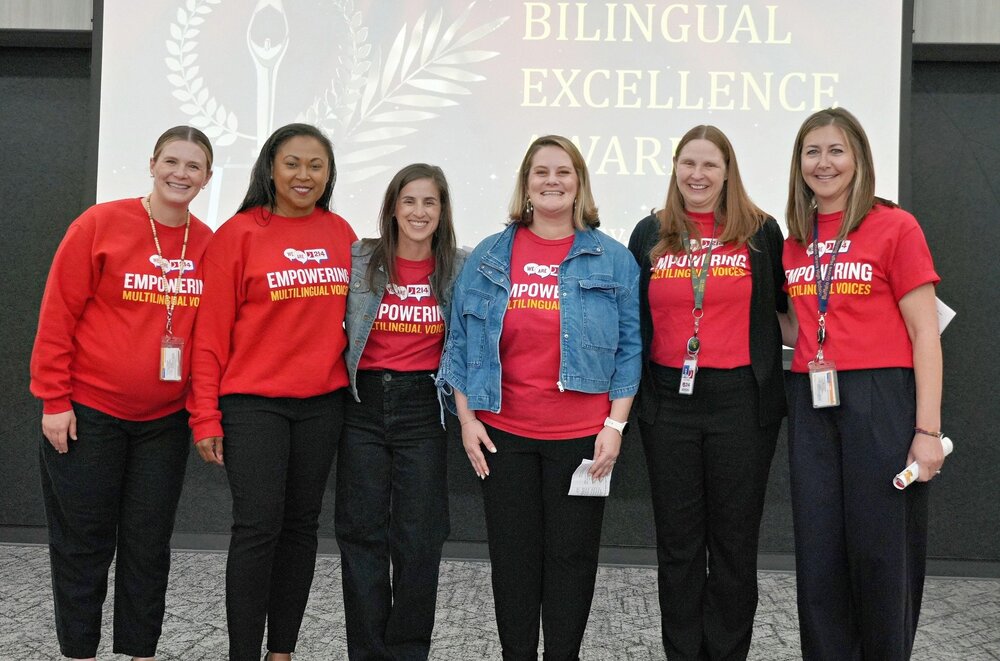
The district has also made student identity more visible. Through the annual Bilingual Excellence Awards, building-level celebrations and Multilingual Learner Advocacy Month, students are being recognized for growth, leadership and achievement. Board members noted the power of celebrating multilingualism and helping students see it as an asset in school, college and careers, with Board member Mary Kay Baldino noting: “We live in a global economy. Global employers where language skills are very important.”
Looking ahead, District 214 is focused on four strategic priorities: developing EL-ready curriculum and instruction, building EL-responsive classrooms, extending belonging beyond the EL classroom and strengthening supports for students with interrupted schooling.
Gott and Board members attributed the District’s dramatic programming growth to the collective work of teachers, division heads, school leaders, counselors, social workers, interpreters, family liaisons, support staff and district leaders.