
Artificial intelligence is reshaping how industries operate and redefine the skills required in today’s technology workforce. As AI tools become embedded in software development, cybersecurity, networking and cloud computing, employers seek professionals who can work alongside intelligent systems, adapt to innovation and apply technical knowledge in dynamic environments.
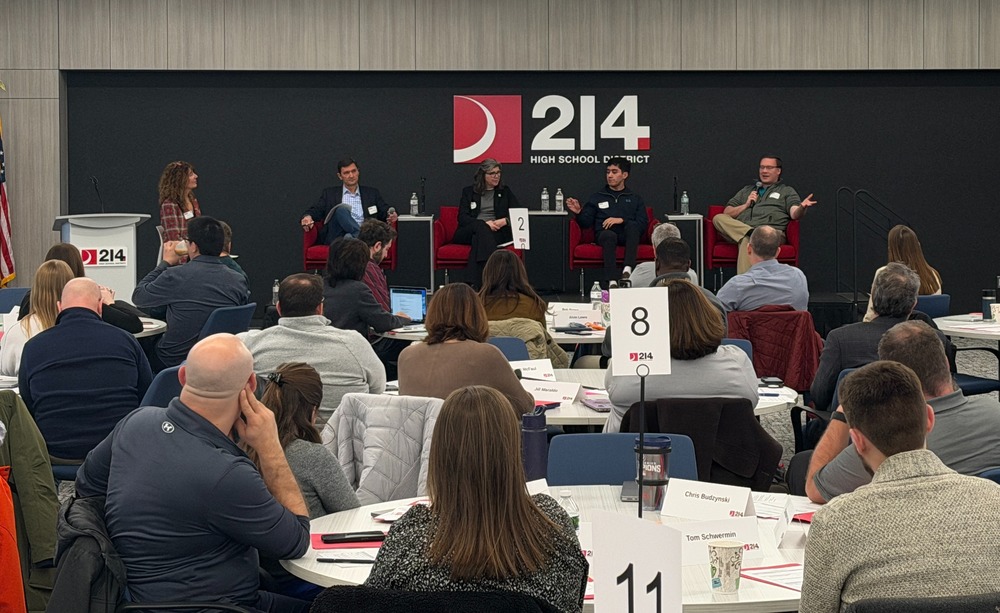
Against this backdrop, District 214 leaders and educators hosted industry partners and higher education representatives on February 24 for an in-depth conversation about the future of Information Technology education. “Our goal is to understand what’s happening in the sector, to ensure that the work we’re doing is relevant to our students. That’s why it's so important that we have employer voices here,” said Dr. Lázaro López, executive director of the District 214 Education Foundation.
Conducted as one step in the District’s IT Pathway Reboot, the session brought together regional and national experts to examine labor market trends, employer expectations, credentialing pathways and student enrollment data in order to strengthen and modernize the District’s IT programming.
Dr. Bradford Hubbard, District 214’s Associate Superintendent for Teaching and Learning, District 214 emphasized the importance of understanding current and future trends to prepare students for high-demand, high-wage careers in programming, cybersecurity, networking and cloud computing. “We want a fresh lens and set of eyes with all of our industry partners,” he said. “We are trying to reimagine what this pathway can and should be to keep up with the demands of the industry.”
Participants said preparing students requires more than foundational coding or hardware skills. It calls for critical thinking, problem-solving, collaboration and an understanding of how emerging technologies influence nearly every sector of the economy.
A review of regional workforce data highlighted strong demand in IT fields across the Chicago region. Programming, cloud computing, networking and cybersecurity continue to offer significant career opportunities for students who graduate with technical skills and hands-on experience paired with industry credentials. The discussion reinforced that many employers value certifications and applied skills alongside postsecondary education.
A local employer panel featuring representatives from Google, Cisco, the City of Rolling Meadows and regional technology firms shared insight into what they seek in entry-level hires and interns. Employers emphasized problem solving, communication, adaptability and the ability to apply technical knowledge in real-world settings.
Representatives from College Board, Harper College and cybersecurity innovation partners discussed credential alignment, Advanced Placement coursework and postsecondary pathways. District 214’s IT pathway already offers college credit opportunities, industry credentials and structured workplace learning experiences. The reboot conversation centered on refining course sequencing and ensuring students move seamlessly from introductory coursework to capstone experiences and employment or postsecondary programs.
Throughout the meeting, participants reflected on key guiding questions: What are we doing well in our IT courses and pathways? What excites us most about the next phase of this work? Those conversations focused on modernization, equitable access and maintaining consistent pathway quality across the district.
“It was a great day. We had so much energy in the room. We’re so lucky to have such a supportive community,” said Jill Hlavacek, District 214’s Director of Curriculum and Equitable Practices. “Based on conversations today, we will reconvene and figure out how to put these puzzle pieces together and what the new pathway will look like.”