
School-based science fairs date back nearly a century, but never has student work been more advanced or impressive than it is in contemporary high schools.
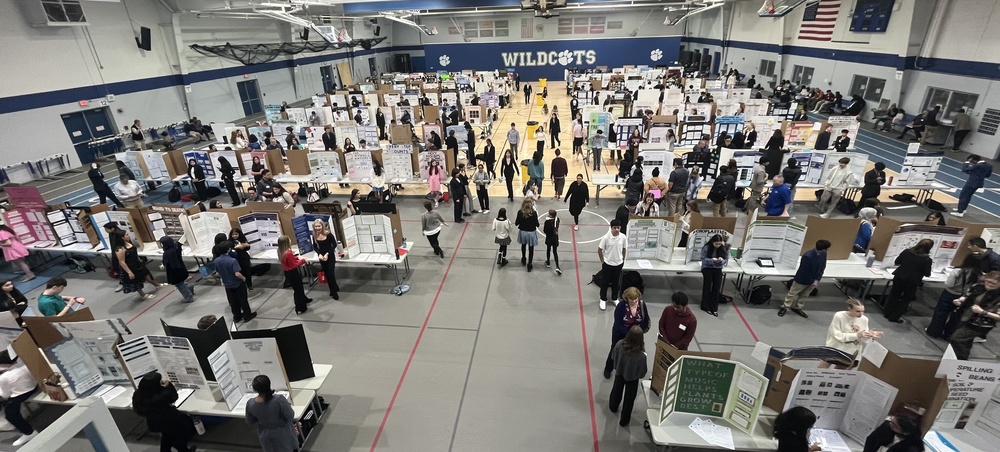
On March 7, Wheeling High School put high-level student research on display by again hosting the Region 6 Science Fair for the Illinois Junior Academy of Science (IJAS). More than 500 student scientists, along with parents and staff from more than 35 schools converged, with projects evaluated by 275 judges.
The Junior Academy of Science mission is, in part, “to present science as a rational observation and systematic investigation of natural phenomena; to stress the importance of critical thinking and logical reasoning…”
So it is that students, encouraged to pursue work of personal interest on essentially any topic, showed judges painstakingly researched projects. Entrants utilized display boards and 30-page papers to summarize and explain scores of hours of lab work that often involves hitting one roadblock after another and then adjusting accordingly to find answers to their original questions.
This aligns with yet another element of the Junior Academy of Science mission, which, paraphrased, is to provide students with insights into the problems faced and methodologies used by scientists and to encourage students to find information concerning new investigations and discoveries.
Reflecting on the effort required of fair participants, Wheeling High School science teacher Kim Milligan said of her own students, “These are some of the hardest-working students I have ever had the privilege to work with. We spent A LOT of hours together in the lab! I could not be more proud of the character they showed throughout the process and the sportsmanship they showed on Saturday.”
Milligan and WHS science colleague Dr. Gregory Wallace said the school succeeds as a host only through the contributions of scores of individuals, including event coordinators, judges, facilities and tech teams, administrators, office and logistics support, alumni and community volunteers, student volunteers and boosters.
Milligan and Wallace also lauded the entire WHS team’s work: “We were proud to be the epicenter of science and to invite more than 1,000 people into the building to see how outstanding WHS is with their own eyes.”